


Asia Pacific Microgrid Market Size, Growth, Trends, Forecast (2024-2032)
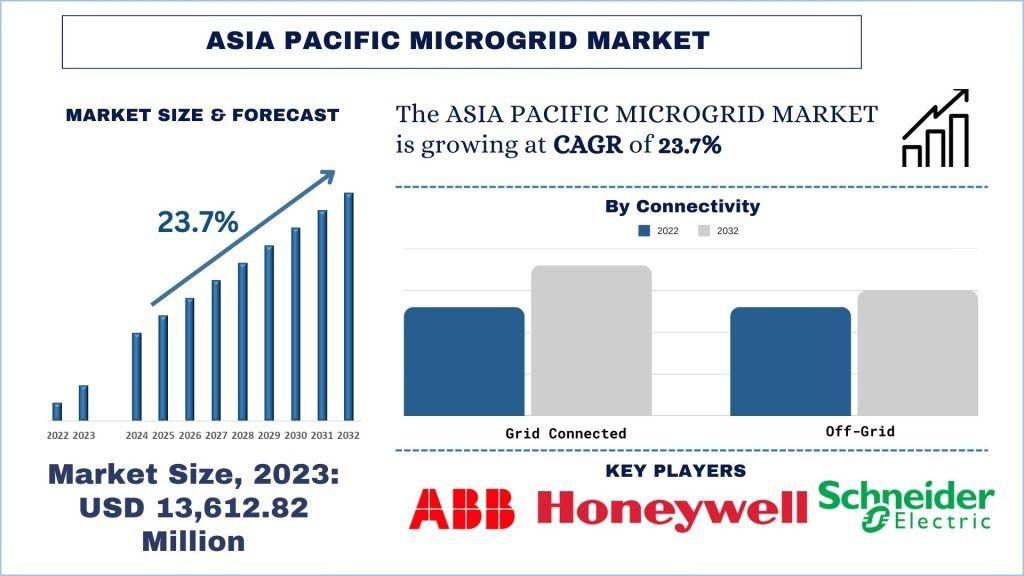
According to a new report by UnivDatos, the Asia Pacific Microgrid Market is expected to reach USD 86,752.74 Million in 2032 by growing at a CAGR of 23.7%.
The Asia Pacific region is currently experiencing a swift shift towards renewable energy sources, motivated by the pressing need to address climate change and attain energy security. Within this changing environment, microgrids have surfaced as a revolutionary answer, facilitating the smooth incorporation of decentralized generation and guaranteeing a reliable power source. The Asia Pacific microgrid sector is set for significant expansion, supported by advantageous government regulations, increasing investments, and technological progress.
Demand:
The Asia Pacific microgrid market is influenced by various factors. To begin with, the region's growing population and fast urbanization have caused a significant increase in energy demand, requiring the implementation of sustainable and effective energy solutions. Furthermore, the region's susceptibility to natural disasters and severe weather conditions has emphasized the importance of energy resilience, leading to installing microgrids to guarantee continuous power supply. Moreover, the Asia Pacific region's dedication to decreasing carbon emissions and addressing climate change has encouraged investments in renewable energy sources, facilitating the integration of microgrids.
Applications:
Microgrids are finding diverse applications across the Asia Pacific region. In remote and isolated areas, microgrids offer a reliable and cost-effective solution for electrification, providing access to clean energy for underserved communities. Major industries, such as manufacturing, healthcare, and data centers, are increasingly adopting microgrids to enhance energy self-sufficiency, reduce operational costs, and mitigate the risks associated with power outages. Furthermore, urban microgrids are gaining traction, enabling the efficient management of energy distribution, peak load shaving, and the integration of distributed energy resources (DERs) like rooftop solar and energy storage systems.
Technological Advancements:
The Asia Pacific microgrid industry is undergoing rapid technological advancements driven by continuous research and development efforts. State-of-the-art energy storage solutions, such as lithium-ion and flow batteries, enable the efficient storage and distribution of renewable energy, thereby improving the reliability and performance of microgrids. Furthermore, integrating smart grid technologies, including advanced metering infrastructure (AMI) and energy management systems, allows for real-time microgrid operation monitoring, control, and optimization.
Access sample report (including graphs, charts, and figures) - https://univdatos.com/reports/asia-pacific-microgrid-market?popup=report-enquiry
Prominent Players:
The Asia Pacific microgrid market is home to a diverse array of prominent players, ranging from established energy giants to innovative startups. Major companies like Schneider Electric, ABB, and Hitachi have leveraged their expertise and resources to develop cutting-edge microgrid solutions. At the same time, startups and research institutions drive innovation by exploring new technologies and business models. Some of the latest developments in the region are as follows:
· In March 2024, Tata Power Solar Systems Limited (TPSSL), a wholly owned subsidiary of Tata Power Renewable Energy Limited (TPREL), announced on March 13, 2023, that it has successfully commissioned India's largest solar battery energy storage systems project in Rajnandgaon, Chhattisgarh. The project comprises a 100 MW Solar PV unit and a 120 MWh Utility Scale Battery Energy Storage System (BESS). TPSSL had bagged this Rs 945-crore project on an EPC (Engineering, Procurement, and Construction) basis from the Solar Energy Corporation of India Ltd (SECI) in December 2021.
· In March 2024, the Australian Government announced up to USD 1 billion in funding for the Solar Sunshot program to build Australia’s solar photovoltaic (PV) manufacturing capabilities. The program aims to support innovative manufacturing facilities across the solar PV supply chain in Australia. The solar PV supply chain includes polysilicon production, ingots, wafers, solar PV cells, and solar module assembly. The program may also support complementary aspects of the solar PV supply chain, such as solar glass, module frames, deployment technology, and other innovation or manufacturing elements required for solar deployment.
Conclusion:
The Asia Pacific microgrid market is poised for substantial growth, driven by the region's ambitious renewable energy targets, the need for energy resilience, and the increasing adoption of decentralized energy systems. With favorable government policies, rising investments, and technological advancements, the region is well-positioned to harness microgrids' full potential, paving the way for a sustainable and resilient energy future.
Key Offerings of the Report
Market Size, Trends, & Forecast by Revenue | 2024−2032.
Market Dynamics – Leading Trends, Growth Drivers, Restraints, and Investment Opportunities
Market Segmentation – A detailed analysis of Components, Types, connectivity, power sources, storage, and Applications.
Competitive Landscape – Top Key Vendors and Other Prominent Vendors
Contact Us:
Email - contact@univdatos.com
Website - www.univdatos.com


 Deutsch
 English
 Arabic
 עברית
עברית
 French
 Spanish
 Portuguese
 Turkish
 Dutch
Dutch
 Italiano
 Russian
 Romaian
 Portuguese (Brazil)
 Greek
Greek